







Sacculina
The Sacculina (full name Sacculina carcini) is a species of barnacle that can only be recognized as a barnacle by its strange larvae. These guys have no hard shells, and no limbs;, not much at all recognizable as a barnacle. They’re composed of external filaments and an internal fleshy sac containing all of the organs that are used for reproduction. Sacculina are parasites of swimming crabs, which generally inhabit shallow waters. They attach to their hosts and grow into them, hijacking their brains to universally behave like a pregnant female crab, caring for the parasitic larvae as if they were their own eggs. Because of this, Sacculina are nicknamed “crab hackers”.
Gall crab
Gall crabs are tiny crabs that inhabit coral. There are 50 different species of gall crabs and all of them settle into depressions in coral as larvae to avoid predators. The coral around these crabs grows in specific shapes and patterns, but scientists don’t yet understand how this happens. Upon inhabiting the coral, gall crabs will feed on the mucus that the coral produces or snatch algae that they can reach from their little spaces. They can be found just about anywhere you can find coral. Interestingly, these crabs have fluorescent properties to aid in camouflage.
Lamprey
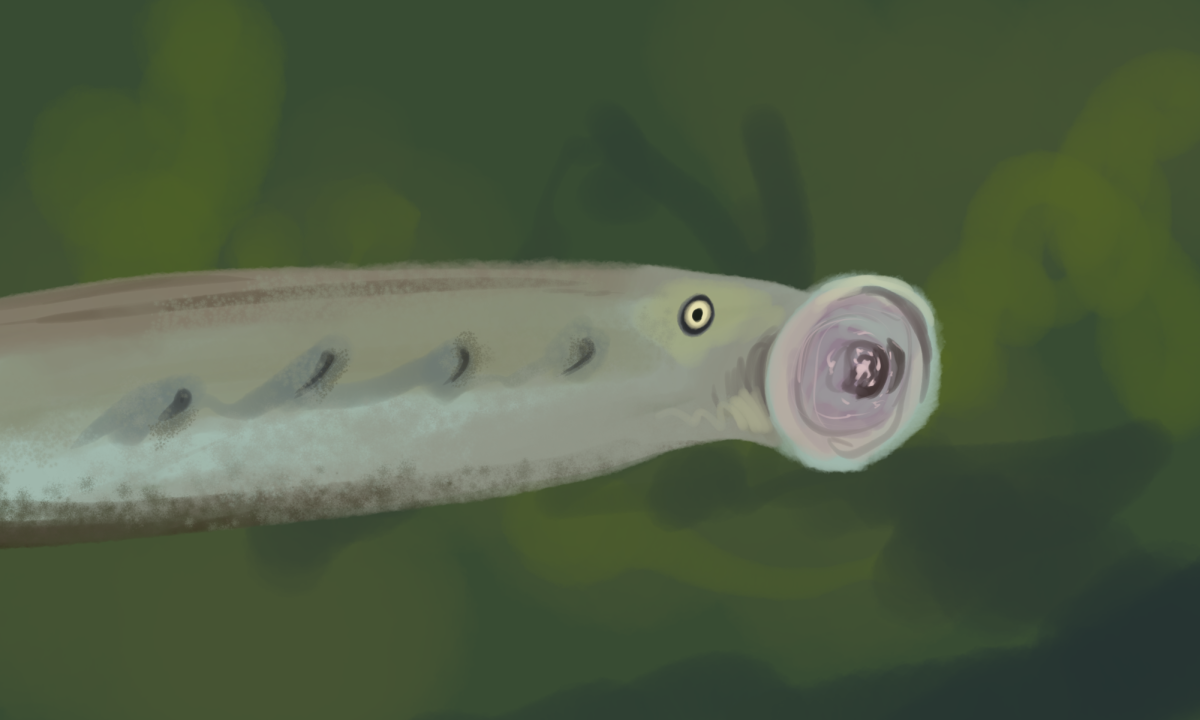
Lampreys are ancient parasitic fish native to the Atlantic Ocean. Lampreys have no scales or fins but a sleek, eel-shaped body. They’re well known for invading the Great Lakes region in the 1830s, which destroyed the habitat and the fishing industry in that area. Lampreys have a disc-shaped mouth with many sharp teeth in circular rows. They use these to latch onto fish and consume their blood and other fluids; one lamprey can consume as much as 40 pounds of fish each year.
Works Cited
Olson, Danielle. “7 Ocean Parasites Worth Celebrating on World Parasite Day.” Smithsonian Ocean, https://ocean.si.edu/ocean-life/7-ocean-parasites-worth-celebrating-world-parasite-day. Accessed 10 February 2026.
“What is a sea lamprey?” NOAA’s National Ocean Service, 16 June 2024, https://oceanservice.noaa.gov/facts/sea-lamprey.html. Accessed 10 February 2026.
Hosie, A.M. 2008. Sacculina carcini Crab hacker barnacle. In Tyler-Walters H. and Hiscock K. Marine Life Information Network: Biology and Sensitivity Key Information Reviews, [on-line]. Plymouth: Marine Biological Association of the United Kingdom. [cited 10-02-2026]. Available from: https://www.marlin.ac.uk/species/detail/2233
Bähr, S., E.T. van der Meij, S., Terraneo, T., Oury, N., Michiels, N.K, Ogg, S., Marchese, F. & Benzoni, F. Integrative phylogenomics sheds light on the diversity and evolution of fluorescence in coral-dwelling gall crabs. Proceedings of the Royal Society B 292, 20242043 (2025)