

















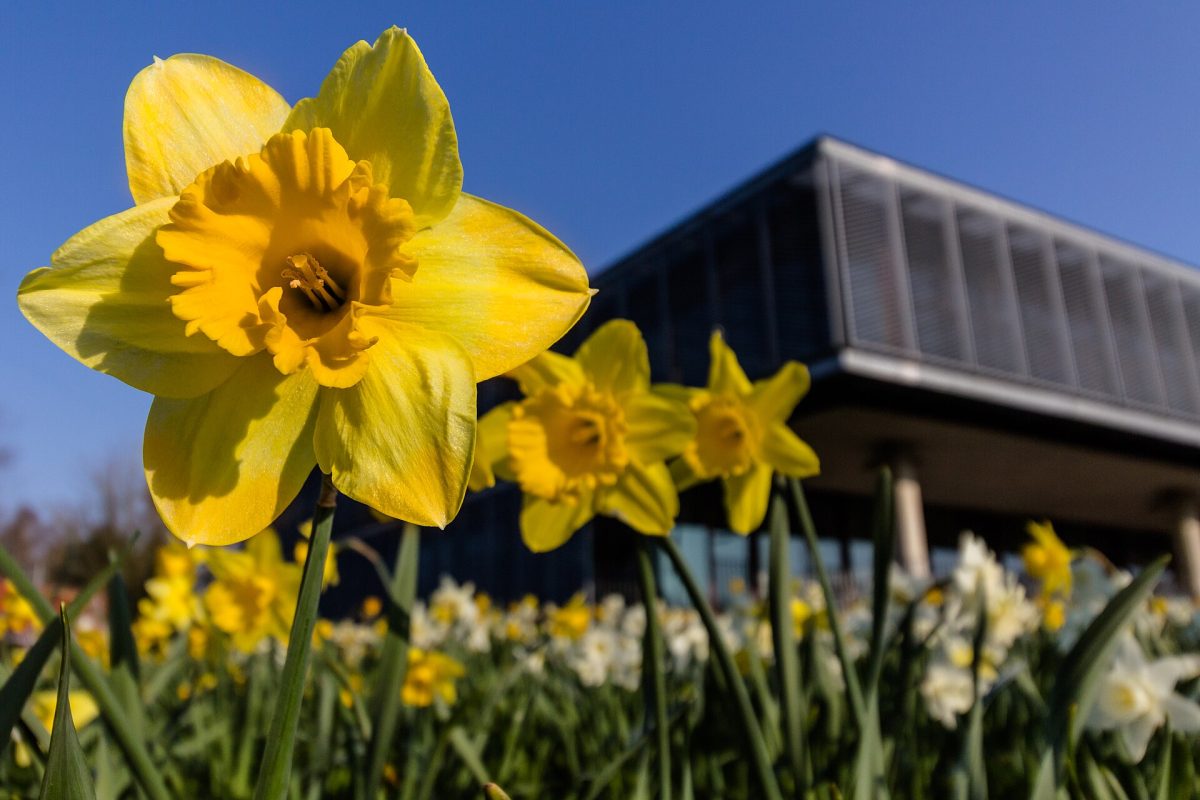
With spring fast approaching, Earth wakes up again, ready to sprout anew. Blood runs through her body again, and the grass, the trees, and the flowers rush back to life with a newfound vitality. Some wake up earlier, eager to embrace the sun and the rush of life, while others take their time. Among the early birds is the daffodil, March’s birth flower. Its early bloom time, Mediterranean origin, and cheery yellow hue are a perfect resemblance to the world as it wakes up again.
Many possible origins exist for the daffodil’s names. The word “daffodil” came from the word “affodell”, a variant of asphodel, a similar-looking Mediterranean plant. However, the daffodil doesn’t just have one name; it’s also known as “narcissus”. Narcissus originates from the Greek narkissos, which may be connected to the plant’s numbing properties, with narkē meaning numbness. A far more interesting association is with the Greek myth of Narcissus, a man cursed with self-obsession to the point where he grew so obsessed with seeing his reflection in the water that he eventually fell in and drowned, resulting in daffodils springing up where he died. There is no concrete evidence that this is connected to the name of the flower, but if it is, it’s definitely one of the most interesting ways a flower has been given its name.
Daffodils are globally beloved for symbolizing the end of winter and the arrival of spring as one of the earliest flowers to bloom during this time. They are also popular in general, as they are often seen in Greek, Roman, Western, Chinese, and Islamic cultures. The daffodil is Wales’ national flower, being associated with Saint David’s Day on March 1st. Although they originated in Europe, they were brought to the East via Arab traders on the Silk Road. They are frequently mentioned in Roman, Greek, and European works of art, especially paintings. Daffodils are popular ornamental flowers in both Chinese and Islamic cultures, with them being tied to the Chinese New Year, bringing prosperity, fortune, and luck. Daffodils have also been used traditionally as medicine, although they are highly dangerous and known for inducing vomiting. They are still carefully used today, as they contain toxic alkaloids that can be extracted to treat those with dementia and Alzheimer’s.